
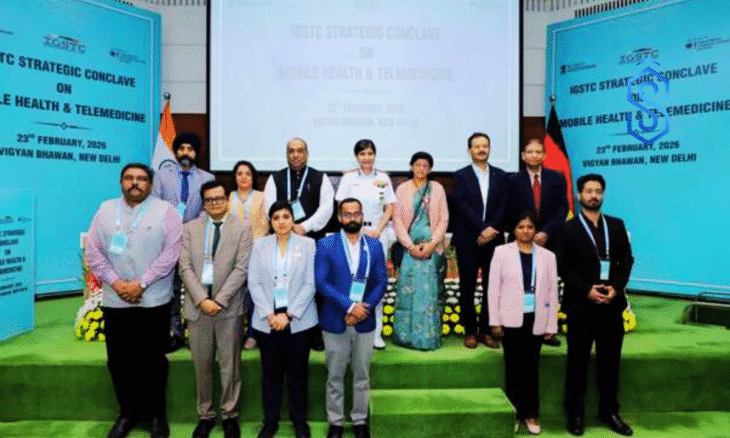
New Delhi: The IGSTC Strategic Conclave 2026 on “Mobile Health & Telemedicine” brought together policymakers, scientists, healthcare leaders and industry experts at Vigyan Bhawan, New Delhi, to deliberate on strengthening digital health ecosystems through innovation-led Indo-German collaboration.
The IGSTC Strategic Conclave 2026 focused on advancing mobile health technologies, telemedicine infrastructure and translational research to address systemic healthcare challenges across India.
Organised under the aegis of the Department of Science and Technology (DST) and the Biotechnology Industry Research Assistance Council (BIRAC), the IGSTC Strategic Conclave 2026 served as a multi-stakeholder platform to foster dialogue between government, academia and industry.
Dr. Kusumita Arora, Director, Indo-German Science & Technology Centre (IGSTC), explained that the conclave aimed to bring key stakeholders to a common discussion forum, including leaders from government sectors, healthcare specialists, academic researchers and industry experts.
She noted that conversations among these three pillars of the science and technology innovation landscape are expected to drive progress forward and move beyond research discourse toward co-creation of solutions for unresolved technical challenges.
Also Read: Deep-Tech Startup Gudlyf Mobility Receives TDB-DST Support for 700 Bar Hydrogen Storage Technology
Telehealth as a Strategic Healthcare Vertical
Surg VAdm Dr Arti Sarin, Director General Armed Forces Medical Services (DGAFMS), elaborated on the strategic importance of telemedicine in the Armed Forces Medical Services during the IGSTC Strategic Conclave 2026.
She stated that telehealth has emerged as a critical vertical within the armed forces’ healthcare ecosystem, which serves approximately 1.6 crore personnel, veterans and their families.
She highlighted the evolution of telemedicine from early real-time consultations to satellite-enabled platforms supporting maritime deployments and remote high-altitude areas.
She emphasised the need for secure, encrypted communication systems, wearable health tracking devices, AI-enabled diagnostics and regulatory clarity to ensure ethical and resilient telehealth systems in sensitive operational environments.
Biotechnology and Startup-Driven Digital Health Innovation
Addressing the IGSTC Strategic Conclave 2026, Dr. Jitendra Kumar, Managing Director, BIRAC, underscored the critical role of biotechnology-led innovation in strengthening digital health delivery. He stressed the importance of supporting startups and innovators working at the intersection of diagnostics, digital platforms and medical devices.
He noted that structured funding support, mentorship and regulatory facilitation are essential to prevent talent migration and ensure that Indian innovations are translated into accessible healthcare solutions.
He emphasised that international collaboration, including Indo-German partnerships, can help co-create solutions suited to India’s diverse healthcare landscape while leveraging global standards and expertise.
Also Read: DST Launches India Netherlands Hydrogen Fellowship, IITs Sign MoU with University of Groningen
Telemedicine Integration Under National Digital Health Mission
Dr Sunita Sharma, Director General Health Services (DGHS), highlighted the integration of telemedicine within India’s expanding digital health landscape under the National Digital Health Mission at the IGSTC Strategic Conclave 2026. She noted that telemedicine services are now available up to the Ayushman Mandir level, enabling access to healthcare in rural and underprivileged areas.
She emphasised the importance of artificial intelligence, machine learning and point-of-care technologies, particularly for national programs such as tuberculosis eradication.
She also underlined the need for strong regulatory mechanisms, data privacy safeguards and sustained funding to ensure responsible adoption and prevent misuse of emerging technologies.
Industry Expectations and Translational Research
Pavan Chaudhary, Chairman of the Medical Technology Association of India, narrated industry expectations and emphasised the need for focused translational research and an incentivised approach to accelerate innovation.
Dr. Arindam Bhattacharyya from the Department of Science and Technology underscored the importance of building innovation ecosystems that integrate science, technology and public health priorities during the IGSTC Strategic Conclave 2026.
He emphasised that telemedicine and mobile health technologies must move beyond pilot stages and evolve into scalable, sustainable platforms capable of addressing systemic healthcare challenges, particularly in underserved and remote regions.
He highlighted the role of DST in fostering collaborative research, supporting translational pathways and enabling strategic partnerships between academia, startups and industry to accelerate deployment of deep-tech healthcare solutions.
IGSTC Strategic Conclave 2026: Focus on AI, Wearables and Regulatory Frameworks
The IGSTC Strategic Conclave 2026 deliberated on emerging technologies including AI-enabled diagnostics, remote patient monitoring, wearable devices and chip-based laboratory services. Discussions also focused on regulatory frameworks, data protection, financing mechanisms and strategies to address the digital divide.
Participants emphasised the need for bilateral research collaborations, industry-academia partnerships and structured R&D roadmaps to accelerate the development of deep technologies suited to India’s diverse geographic and socio-economic conditions.